

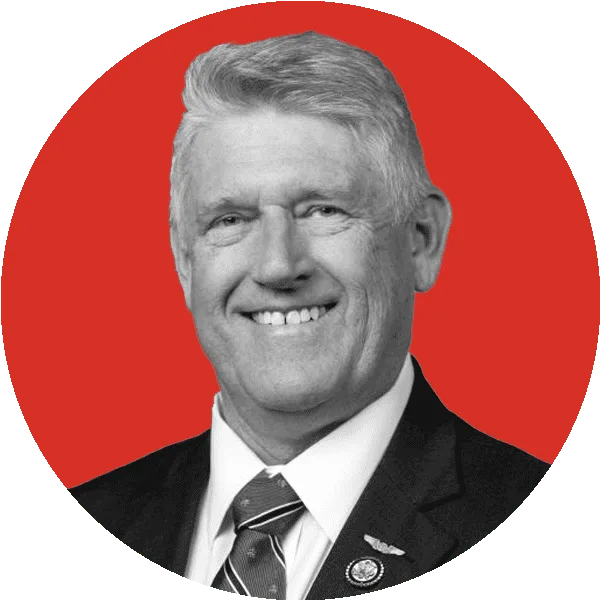
Michael D Eisenhauer
Active candidates for U.S. House District 2 (East)
Republican
Democrat

Libertarian

Independent
Campaign links

ON THE ISSUES
The responses reproduced here were solicited from candidates via a written questionnaire conducted by Montana Free Press in March 2026. Responses were limited to 1,000 characters and have not been edited or fact-checked.
I believe strongly in the principles of constitutional governance, accountability, and adherence to the rule of law. In that context, the War Powers Resolution of 1973 (WPA) should be enforced. The WPA is federal law designed to limit the President's authority to wage war without congressional authorization, requiring the president to notify Congress within 48 hours of deploying troops and limiting engagement to 60 days unless Congress authorizes longer action. By law, the President must also provide a full account of the “circumstances under which such hostilities were initiated, the estimated scope and duration of such hostilities, and the constitutional and legislative authority under which the introduction of hostilities took place.” I believe that that no branch of government should act unilaterally in matters as serious as war, and existing laws designed to preserve that balance should be upheld and improved rather than ignored.
If there are concerns about ambiguity or lack of compliance, the priority would not be to discard the law but to strengthen or clarify it so that its requirements are more explicit and enforceable.
Montana’s critical-access and rural healthcare system must be maintained. As a Cardiologist, I know that delays of even an hour in the care for emergencies such as a heart attack or stroke can mean the difference between life and death.
 That said, 20% of our economy is now spent on healthcare, which is unsustainable. Millions of Americans are now seeing their health insurance costs increasing disproportionately because of the One Big Beautiful Bill (OBBB), which also canceled Medicaid support and eliminated subsidies. About 2/3 of Montana Medicaid recipients reside in rural areas. There is no question that the OBBB directly threatens the ability for Montana’s 47 rural health facilities to remain financially viable (or maintain current service levels).

 An Independent Representative can think out of the box in ways that differ from others who are constrained by party dogma. Any successful effort must first protect the ability to see the doctor of your choice, and must retain coverage for preexisting conditions. I do not think a single-payer system will work. Above all else, I will fight hard to protect rural healthcare in Montana, because I believe in it and know what it does.
The Montana Plan: I strongly support the Transparent Election Initiative (TEI) that aims to ban corporations from “dark money” spending money on elections or ballot issues, and is intended to counter the effects of Citizens United. The broader TEI also increases transparency, and improves confidence in the electoral system by returning more control back to citizen voters. • If elected, I will champion the Montana Plan in Congress!
Family Farms and Ranches underpin Montana’s economy, our national security, and our way of life. Due to blunders in trade policy and consolidation at every level of the industry, we face a perfect storm; our federal government too often underwrites multi-national corporations at the expense of family farmers.
• Conventional short-term bailouts do not help; we need long-term solutions.
• The sale of agricultural lands or assets to foreign and large multi-national corporate entities must be curtailed.
• We must address the lack of competition for input suppliers (equipment, seed and fertilizer, etc.); this will very likely require significant anti-trust legislation and legal enforcement.
• Congress must take back control over tariffs and trade policy.
When comparing average income to Montana’s average home price, we have the single least affordable market in the nation. Fixing this housing crisis will require an “all of the above solution”:
• Enact new laws that will allow all mortgages to be transferable with minimal penalty, thereby freeing up home equity • Tax incentives to municipalities (and builders) to open larger tracts of land for development and remove barriers to multi-family housing in residential areas. • Enforce antitrust laws against real estate entities that are “price-fixing” rents • Significant down-payment assistance to 1st-time homebuyers • Property tax relief to qualified homeowners, and to 1st-time homebuyers for the first 3 years • Targeted reductions in capital gains taxes for older homeowners who want to downsize • Improve financing terms (rate adjustments or subsidies) for qualified purchase/rehab/repair loans • Prioritize offers from buyers at foreclosure auctions who plan to live in the home • Increase property tax rates for corporate or large-volume private-equity landlords (this will require these increases are not passed through to individual renters) • Reduce tariffs on lumber and building supplies
I am not a typical politician; my thinking is framed as moving away from a traditional political or ideological approach, to a less partisan one grounded in professional expertise, public service, and practical problem-solving – along with a strong emphasis on accountability, constitutional principles, and real-world outcomes.
My career as a physician and longtime senior military officer has given me significant experience in making high-stakes decisions under pressure, using an evidence- or merit-based approach to decision making while maintaining a focus on patient (constituent) well-being.
Leading with anger or combativeness is not effective – there is far too much vitriol in today’s politics. I am offering a less partisan and more pragmatic approach to representation as an ‘adult in the room’ so-to-speak, while working to reduce political polarization by collaborating with others from both sides of the aisle who can put the needs of the people above party.
As an Independent Representative, I will align my votes with Montanans’ needs or desires, and will not be beholden to either party bosses or political elites. I won’t wait for others to tell me what to do or how to vote.
MTFP COVERAGE OF Eisenhauer
CAMPAIGN FINANCE
Election outcomes
No party primary was conducted.
About this project
This guide was produced by the Montana Free Press newsroom with production by Tom Lutey, Brad Tyer, Amanda Eggert and Jacob Olness, web development by Jacob Olness, editing by Brad Tyer, and contributions from Mara Silvers, Zeke Lloyd and Stephanie Farmer. Contact Jacob Olness with questions, corrections or suggestions at jolness@montanafreepress.org.
Montana Free Press is a nonpartisan 501(c)(3) nonprofit, reader-supported news organization serving Montana. MTFP's donor base includes supporters from across Montana's political spectrum, including some Montanans who are candidates in this year's election. MTFP's major donors are listed here, and a current list of other supporters is available here. MTFP news decisions are made without donor involvement.
This material is available for republication by other media outlets under Montana Free Press' standard distribution terms.