
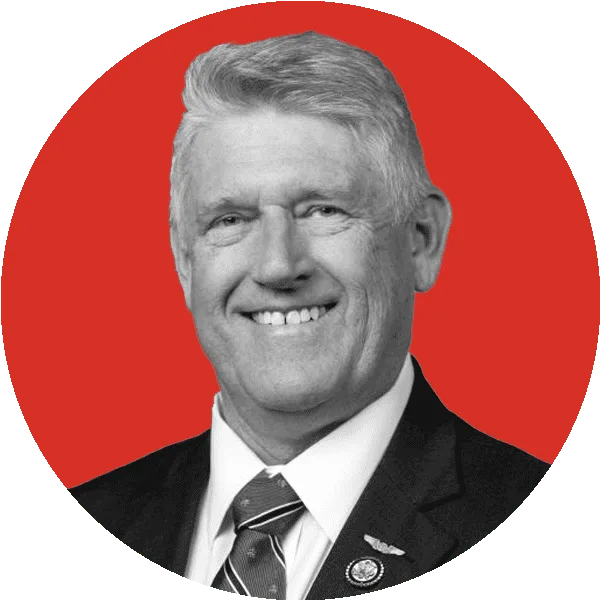
Troy Downing
Active candidates for U.S. House District 2 (East)
Republican
Democrat

Libertarian

Independent
Campaign links

ON THE ISSUES
The responses reproduced here were solicited from candidates via a written questionnaire conducted by Montana Free Press in March 2026. Responses were limited to 1,000 characters and have not been edited or fact-checked.
Congress has a constitutional responsibility to declare war, and the War Powers Resolution of 1973 was intended to reinforce that role. The Constitution also designates the President as Commander in Chief, with the authority to act swiftly to protect Americans and our interests. In recent situations, the President notified congressional leadership and acted within the framework that allows limited military engagement while Congress reviews the situation. If operations extend into sustained combat, Congress must provide formal authorization or determine the appropriate course forward. This balance ensures the President can respond to immediate threats while preserving Congress’s constitutional duty to oversee and authorize extended acts of war.
Rural healthcare and critical access facilities are essential to Montana. I make it a priority to visit these communities and understand the realities facing this vital part of rural infrastructure. Workforce development is one of the most pressing challenges. Many facilities struggle to recruit and retain the providers and caregivers they need to serve their communities effectively. Facilities must also be right-sized to meet the needs of their regions, ensuring they have the capacity not only for emergency services, but also for routine care and, in many cases, long-term care. Funding remains critical. With aging populations across rural Montana, Medicare and Medicaid account for a significant portion of facility revenue. Reforms to Medicaid will help ensure more resources go directly to patient care while reducing waste and fraud. I also strongly supported the $50 billion in Rural Healthcare Transformation funding appropriated last year, with Montana receiving a significant share of these much-needed investments. Finally, we must improve CMS accountability. Delays in hospital reimbursements and Medicaid redeterminations are unreasonable and place unnecessary strain on providers, especially in rural areas with limited resources.
Energy and Resource Jobs: Montana plays a vital role in American energy production. I will continue to support policies that protect good-paying jobs and ensure a reliable, affordable energy supply. At the same time, I believe we must position the United States as a leader in innovation by advancing technologies that strengthen our energy future and drive economic growth.
Public Land Access: Access to public lands is central to Montana’s way of life. I’m proud of the work I’ve done and will continue working with local stakeholders to maintain access while supporting responsible land management and natural resource development. As a member of the bipartisan Public Lands Caucus, I have consistently opposed proposals to sell off our public land. I believe these lands are a shared resource that must be preserved, protected, and responsibly managed for current and future generations of Montanans.
In Congress, Ive taken a practical, supply-focused approach to improving housing access and supporting homeownership. By introducing the Whole-Home Repairs Act to help families afford critical repairs, preserve existing housing stock, and keep Montanans in their homes. I've also supported policies that expand access to capital and reduce regulatory barriers that make it harder to build new housing. Increasing supply and encouraging responsible development are essential to improving affordability. I have also introduced a bipartisan bill to reauthorize the Native American Housing Assistance and Self Determination Act (NAHASDA) to make sure that Indian Country is not forgotten in our national discussions on housing. My focus is on real solutions, protecting existing homes, supporting new construction, and ensuring more Montanans have the opportunity to achieve the American Dream of homeownership.
My approach is grounded in accessibility, accountability, and results. I’ve focused on constituent services, returning resources to communities, and maintaining a strong presence across the district. I have and will continue to prioritize listening to all Montanans, addressing concerns directly, and working to deliver practical outcomes no matter what side of the isle you are on. It is the honor of a lifetime to serve Montana in Congress and I don't take this responsibility lightly.
MTFP COVERAGE OF Downing
CAMPAIGN FINANCE
Election outcomes
| Candidate | Votes | Percentage |
|---|---|---|
| TROY DOWNING | 82,075 | 100.0% |
About this project
This guide was produced by the Montana Free Press newsroom with production by Tom Lutey, Brad Tyer, Amanda Eggert and Jacob Olness, web development by Jacob Olness, editing by Brad Tyer, and contributions from Mara Silvers, Zeke Lloyd and Stephanie Farmer. Contact Jacob Olness with questions, corrections or suggestions at jolness@montanafreepress.org.
Montana Free Press is a nonpartisan 501(c)(3) nonprofit, reader-supported news organization serving Montana. MTFP's donor base includes supporters from across Montana's political spectrum, including some Montanans who are candidates in this year's election. MTFP's major donors are listed here, and a current list of other supporters is available here. MTFP news decisions are made without donor involvement.
This material is available for republication by other media outlets under Montana Free Press' standard distribution terms.